Last week, we spent some time talking about why people read and what happens in a reader's mind while he or she is reading. We also shared the things we love to read that paint a picture of our lives as readers. Here are the notes from our conversations:
Tuesday, September 21, 2010


Wednesday, September 8, 2010
Happy First Day of School!
We had a tremendous first day! It was so lovely to put faces with the names on my class list. At the end of the day today, we had a "Setting of Intentions." We started by talking about why we go to school in the first place. These are the ideas that came up:
The conversation then moved to why school matters to each individual student, to why each individual student comes to school (looking beyond the legal obligation, that is). We talked about the word "intention," that it means a plan to act a certain way. Then each student set his or her intention for the year by answering the question, Why do you go to school? Why does school matter to you? The responses will guide their actions during the months to come. Here are their responses:
- Our parents can't have us at our house all day (they don't want to homeschool us).
- so we can learn so we can get jobs
- we like learning
- so there's a place to learn how to be a teacher
- to learn
- to get smarter
- to be challenged
- to be inspired
- to be interested in things
- to make friends and play
- to learn about things you never knew you could learn
- to solve problems (school problems and friend problems)
The conversation then moved to why school matters to each individual student, to why each individual student comes to school (looking beyond the legal obligation, that is). We talked about the word "intention," that it means a plan to act a certain way. Then each student set his or her intention for the year by answering the question, Why do you go to school? Why does school matter to you? The responses will guide their actions during the months to come. Here are their responses:
Tuesday, August 10, 2010
Summer Welcome & School Supply List
Hello Families!
I hope you are in the midst (yes, midst--it's not over yet!) of a most glorious summer. I am enjoying a lovely mix of time at home in Williamsburg, travel, and a wacky summer job on a friend's frozen yogurt truck. I am very much looking forward to September, and I hope you are too. I can't wait to meet you all then! If you have questions or would like to say hello, please email me at playsoutside@gmail.com (note the "s" in "plays"). Please click here to access the school supply list. See you soon!
Warmly,
Lauren
Friday, May 21, 2010
Algebraic Expressions for Patterns in Perimeter
Last week, we collected data for how the perimeter changes when you add a row of tiles to a 1 x 3 rectangle:


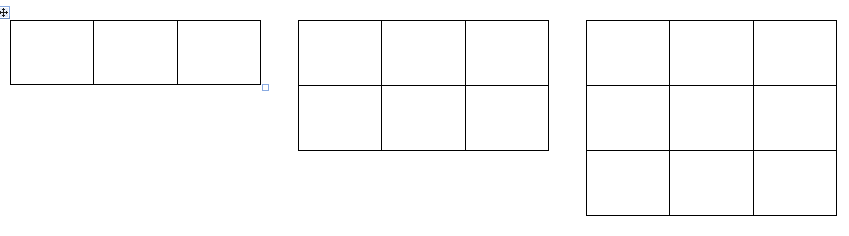
The first rectangle has a perimeter of 8, the second 10, and the third 12. Can you predict the perimeter of the fourth rectangle? The fifth? You probably can. It increases by 2" each time you add a row. Our first job was to figure out why. This student work explains why the perimeter increases by two each time you add a new row:


Next, we wanted to find out if we could find the perimeter of any number of rows without finding all the perimeters before it. We wanted to find the perimeter of a rectangle with 100 rows without knowing the 99th. We came up with these algebraic expressions for finding the perimeter for any number of rows (where n is the number of rows and the length equals three):
(n + 3) x 2
(n-1) x 2 + 8
2n + 6
Once we knew that these expressions worked, we tried to find out why they work. Here's what we discovered:
(n + 3) x 2


(n-1) x 2 + 8

2n + 6


A note to grownups: The first algebraic expression, (n + 3) x 2 is a formula for perimeter. n is the number or rows, or the width, and 3, in this example, is the length. (length + width) x 2 = perimeter. Our purpose here wasn't to find a formula for calculating perimeter (which most students know how to do), it was to write equations that fit this situation and then figure out why they work.
Thanks for reading.
Friday, April 30, 2010
A Division Mystery: The Meaning of Remainders
We encountered a puzzling situation with remainders this week. Until now, the students expressed remainders as R4, for example, rather than as a fraction or decimal. The problem that arose this week helped build the conceptual understanding of what remainders are all about, and now we know why you express remainders as a fraction or decimal, not just that you express remainders as a fraction or decimal.
One strategy the students use to solve a division problem is to make an easier, equivalent problem by dividing the dividend and the divisor by the same number, which won't effect the quotient (12 / 2 = 6 / 1). When they used that strategy to solve 376 / 6, however, they encountered a problem--halving and halving didn't produce the same remainder as other strategies, but no one could find an error in their work. We revisited the problem today, and everyone tried to figure out why the remainders were different. We ended with a meeting to discuss our findings. Here's the original question as well a poster that shows our conclusions:
A Division Mystery
Students solved 376 / 6 in different ways on Wednesday. Two different answers came up, but there doesn’t seem to be a calculation error in either strategy. What’s happening here?
376 / 6
Strategy 1
60 x 6 = 360
2 x 6 = 12
376 - 372 = 4
376 / 6 = 62 R4
Strategy 2
376 / 6 = 188 / 3
60 x 3 = 180
2 x 3 = 6
188 – 186 = 2
188 / 3 = 62 R2
376 / 6 = 62 R2
The students worked together to come to the following conclusion, and several students volunteered to make this poster:

Thursday, April 22, 2010
ELA Monday and Tuesday
Hi Families,
Just a reminder that the ELA is Monday and Tuesday. Day 1 will be 45 minutes, and the students will answer approximately 25 multiple choice and some short answer questions. Day 2 will be 50 minutes. I'll read an article to the class twice, they'll take notes, and then they'll answer some multiple choice and short answer questions about the passage. The test ends with a brief editing passage.
I administered a practice run of Day 1 of last year's test so the class knows how it will feel. They did really well! I'm sending it home today or tomorrow in case you want to see what Monday will be like.
You've heard it before, but remember that the best thing for your kids to do on testing days is to sleep tight and breathe easy!
You've heard it before, but remember that the best thing for your kids to do on testing days is to sleep tight and breathe easy!
Take care,
Lauren
Tuesday, April 20, 2010
The Meaning of "Democracy" and Fate vs. Free Will
We wrapped up our conversation about revolution last week and are not talking about democracy. Today in social studies we looked at several famous quotes (below) about democracy. Each student chose one, and wrote about what he or she thinks the quote means. Tonight's homework is to draw a sketch that shows the quote in action. This would be a lovely project to check out if you're so inclined. If you're looking for something exciting to discuss at dinner, it might be an interesting thing to talk about, as would the philosophical question that came up...
One of the quotes we looked at was credited to Aristotle. We quickly discussed what a philosopher is, and that lead to an interesting conversation about free will vs. determinism, or fate. While this was a bit tangential, it was an interesting conversation, and there are clearly some philosophers in the room. Students, if you'd like to read more about free will vs. fate, page 86 of this book might be of interest (Click "contents" for links to the pages in the book. You might have to play with the zoom to get it to look right. Click and drag to scroll.):
One of the quotes we looked at was credited to Aristotle. We quickly discussed what a philosopher is, and that lead to an interesting conversation about free will vs. determinism, or fate. While this was a bit tangential, it was an interesting conversation, and there are clearly some philosophers in the room. Students, if you'd like to read more about free will vs. fate, page 86 of this book might be of interest (Click "contents" for links to the pages in the book. You might have to play with the zoom to get it to look right. Click and drag to scroll.):
Subscribe to:
Posts (Atom)