Friday, May 21, 2010

Algebraic Expressions for Patterns in Perimeter

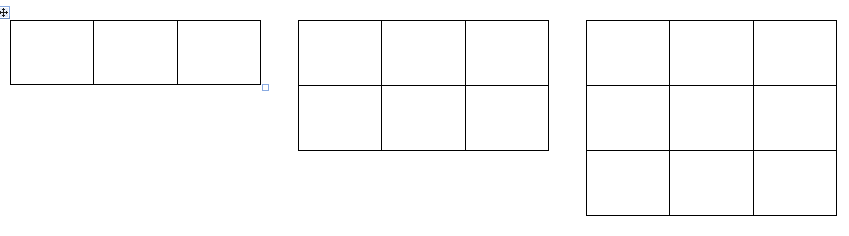
Last week, we collected data for how the perimeter changes when you add a row of tiles to a 1 x 3 rectangle:
The first rectangle has a perimeter of 8, the second 10, and the third 12.  Can you predict the perimeter of the fourth rectangle?  The fifth?  You probably can.  It increases by 2" each time you add a row.  Our first job was to figure out why.  This student work explains why the perimeter increases by two each time you add a new row:


Next, we wanted to find out if we could find the perimeter of any number of rows without finding all the perimeters before it.  We wanted to find the perimeter of a rectangle with 100 rows without knowing the 99th.  We came up with these algebraic expressions for finding the perimeter for any number of rows (where n is the number of rows and the length equals three):

(n + 3) x 2

(n-1) x 2 + 8

2n + 6

Once we knew that these expressions worked, we tried to find out why they work.  Here's what we discovered:


(n + 3) x 2


(n-1) x 2 + 8


2n + 6


A note to grownups: The first algebraic expression, (n + 3) x 2 is a formula for perimeter.  n is the number or rows, or the width, and 3, in this example, is the length.  (length + width) x 2 = perimeter.  Our purpose here wasn't to find a formula for calculating perimeter (which most students know how to do), it was to write equations that fit this situation and then figure out why they work.

Thanks for reading.

Friday, April 30, 2010

A Division Mystery: The Meaning of Remainders

We encountered a puzzling situation with remainders this week.  Until now, the students expressed remainders as R4, for example, rather than as a fraction or decimal.  The problem that arose this week helped build the conceptual understanding of what remainders are all about, and now we know why you express remainders as a fraction or decimal, not just that you express remainders as a fraction or decimal.

One strategy the students use to solve a division problem is to make an easier, equivalent problem by dividing the dividend and the divisor by the same number, which won't effect the quotient (12 / 2 = 6 / 1).  When they used that strategy to solve 376 / 6, however, they encountered a problem--halving and halving didn't produce the same remainder as other strategies, but no one could find an error in their work.  We revisited the problem today, and everyone tried to figure out why the remainders were different.  We ended with a meeting to discuss our findings.  Here's the original question as well a poster that shows our conclusions:

A Division Mystery

Students solved 376 / 6 in different ways on Wednesday.  Two different answers came up, but there doesn’t seem to be a calculation error in either strategy.  What’s happening here?

376 / 6


Strategy 1

60 x 6 = 360
2 x 6 = 12
376 - 372 = 4
376 / 6 = 62 R4


Strategy 2

376 / 6 = 188 / 3
60 x 3 = 180
2 x 3 = 6
188 – 186 = 2
188 / 3 = 62 R2
376 / 6 = 62 R2


The students worked together to come to the following conclusion, and several students volunteered to make this poster:

Thursday, April 22, 2010

ELA Monday and Tuesday

Hi Families,

Just a reminder that the ELA is Monday and Tuesday.  Day 1 will be 45 minutes, and the students will answer approximately 25 multiple choice and some short answer questions.  Day 2 will be 50 minutes.  I'll read an article to the class twice, they'll take notes, and then they'll answer some multiple choice and short answer questions about the passage.  The test ends with a brief editing passage.

I administered a practice run of Day 1 of last year's test so the class knows how it will  feel.  They  did really well!  I'm sending it home today or tomorrow in case  you want to see what Monday will be like.

You've heard it before, but remember that the best thing for your kids to do on testing days is to sleep tight and breathe easy!

Take care,

Lauren

Tuesday, April 20, 2010

The Meaning of "Democracy" and Fate vs. Free Will

We wrapped up our conversation about revolution last week and are not talking about democracy.  Today in social studies we looked at several famous quotes (below) about democracy.  Each student chose one, and wrote about what he or she thinks the quote means.  Tonight's homework is to draw a sketch that shows the quote in action.  This would be a lovely project to check out if you're so inclined.  If you're looking for something exciting to discuss at dinner, it might be an interesting thing to talk about, as would the philosophical question that came up...


One of the quotes we looked at was credited to Aristotle.  We quickly discussed what a philosopher is, and that lead to an interesting conversation about free will vs. determinism, or fate.  While this was a bit tangential, it was an interesting conversation, and there are clearly some philosophers in the room.  Students, if you'd like to read more about free will vs. fate, page 86 of this book might be of interest (Click "contents" for links to the pages in the book.  You might have to play with the zoom to get it to look right.  Click and drag to scroll.):


Monday, April 12, 2010

Social Action: Day 1--What's the Recipe for Revolution?

We started our Social Action Study today!  My colleagues and I are happy to be writing this brand new study, and the first day was lovely.  The focus question of our study is, "How do people make change?"  We began by looking at the American Revolution (talk about change!) and thinking about what the "Recipe for Revolution" is--What do all revolutions have?  What are the constants in revolutions?  The variables?  We'll linger here for a few days, then it's on to the Constitution.  Later, we'll see how our definition of revolution stacks up against the other "revolutions"--women's suffrage and civil rights--that we'll be studying.  These are the notes from today's conversation: 

Tuesday, March 16, 2010

Community Writers Series IV: David Bar Katz, Morris' Dad

by Morris and Trevor


Key Words
destiny, belief, importance


What We Learned


  • Your best writing comes when you’re writing something that feels important to you.
  • If you’re not reporting it’s your job to come up with a good, creative story.
  • The most important thing is that you know what’s a good story and what’s not.
  • Some writers write because it’s their destiny--lots of people do what they do because they believe it’s their destiny.

Tuesday, March 9, 2010

The Boston Tea Party

We just finished studying the Boston Tea Party.  We looked at what lead up to it, what the colonists did to avoid it, and what happened as a result.  We’ve focused on the fact that the tea tax was more of a gesture from King George that asserted his power over the colonies, rather than a way to earn money for England.  We also lingered on the idea that the colonists took several steps before they decided to dump the tea in December 1773—The Boston Tea Party was not their first attempt at communicating their displeasure to King George.  Here’s what the class had to say on what lead up to the Boston Tea Party:

1.   One of the only remaining taxes was the tea tax, which the colonists didn’t want to pay, especially since they weren’t represented in Parliament.

2.   They boycotted tea, and when that didn’t work, they refused to unload a November shipment in Philadelphia, New York and Boston.

3.   In New York and Philadelphia, the governors supported the Patriots, and the ships returned to England

4.   The governor of Boston, Governor Hutchinson, did not send the ships back to England.  His sons worked for the British East India Company, and he knew tea in the colonies = money for his sons.

5.   While the Patriots were waiting for a decision from Governor Hutchinson, the Sons of Liberty met to plan what they’d do if he didn’t cooperate with them.  They went to the British East India Company to meet and try to find a solution, but the British East India Company refused to meet with them.

6.   When it was clear that Governor Hutchinson wasn’t going to cooperate, Samuel Adams decided it was time to move forward with the plans to empty the tea into the harbor, and the rest is history.


Today, we talked about the effects of the Boston Tea Party: the Intolerable Acts, which were a series of harsh laws meant to teach the colonists a lesson, and the unification of the colonies around a common goal—they must defend their rights.  At the first Continental Congress, where delegates from almost every colony met to discuss what to do next, Patrick Henry said, “All America is thrown into one mass.  The distinctions between Virginians, Pennsylvanians, New Yorkers, and New Englanders are no more.  I am not a Virginian, but an American!”  At the end of our conversation about what happened after the Boston Tea Party, a student commented that Patrick Henry’s quote about the colonies coming together was like Barack Obama urging republicans and democrats to work together.  The class concluded that good things happen when people put their differences aside and work together (and then erupted into a song about President Obama!  Something from JibJab?  Who knows, but it was amazing!  They never cease to delight.).